










Skip to content

The technology behind every Minutes Network product.MinTech, the telecom technology built by Minutes Network.

A carrier marketplace that measures every route, a hosted switch run in plain English, routing that prices each call to the longest matching prefix, one API for voice, SMS, verification and numbers, AI on the phone line, an Android SDK, and dedicated capacity you can own. Here is how it works, layer by layer.
Every SIP message of every call on a hosted switch, kept
7 days
Every SIP message of every call on a hosted switch, kept
The most the platform fee adds to a call
$0.001
The most the platform fee adds to a call
Languages with published API quickstarts
8
Languages with published API quickstarts
MCP tools, scoped to your API key
33
MCP tools, scoped to your API key

One network, layer by layer.

Every Minutes Network product runs on the same foundations: carrier interconnect, switching, routing, a marketplace that prices and measures routes, and the developer tools that reach all of it from code. Each layer links to the product built on it.

Network and switching

Standard SIP and SMPP at the edge, and a hosted Class-4 switch behind it, so a carrier connects with the softswitch or SBC it already runs.

Interconnect issued with every route

Connecting a route on the PacketExchange marketplace issues its interconnect on the spot. Your switch is recognised by its public IP, a single address or a whole range, or it answers a SIP digest challenge with the username and password issued for that purchase. Every route you hold is reached through one Switch IP.

  • SIP on port 5060 over UDP or TCP, with G.711a, G.711u and G.729
  • Credentials unique to each purchase, encrypted at rest and rotatable in one click
  • SMS over SMPP: bind as a transceiver, transmitter or receiver
  • A call's maximum length worked out from your balance and the route rate, so a trunk cannot run up a debt
  • Test calls from the dashboard, with the SIP response, the cause and the fix in plain English
Fibre patch panels with neatly dressed jumpers

A hosted Class-4 switch, run in plain English

The hosted switch turns an operator into a carrier with no hardware, licences or upkeep. Interconnect customers with their own credit lines, API keys and SIP credentials, bill them at your markup or your own rate deck, and rank your suppliers in the order you set.

  • AI Control: onboard customers, add suppliers, trace routing and check money owed in plain English, with approval before changes apply
  • Failover to the next supplier on the SIP codes you pick
  • Every call rated to the longest prefix, invoiced from settled usage, with payables netted against receivables
  • Every SIP message of every call kept for seven days, read as a ladder
  • Each supplier scored on ASR, ACD, PDD, NER and MOS from the calls it carried
Rows of server cabinets in a cloud data centre

Routing intelligence: the most specific prefix wins, then your rule

Leave the route off a call or message and name a strategy instead. Smart Routing gathers every route that serves the number, prices each one from the rate deck row that matches the longest prefix, and ranks the most specific matches first. Then your rule decides: the lowest rate, the highest stated answer rate, or the most answer rate for the money.

On the hosted switch, a route group puts your suppliers for a destination into one ordered chain, and a failure that another supplier might carry moves the call on.

  • Three strategies on one parameter: cheapest, best_quality or balanced, with balanced as the default
  • Route groups by Least cost, Priority order or Weighted split
  • A 503 or a timeout moves the call on; 401, 403 and 407 stop the chain
  • Route Trace shows the whole decision without dialling: no channel used, nothing billed
  • Every attempt written to the call record, with the buy rate for each
import { PacketExchange } from 'packetexchange';

const px = new PacketExchange({
  apiKey: process.env.PACKETEXCHANGE_API_KEY,
});

// 1. Let Smart Routing pick the best route
//    for a destination...
const { selected } = await px.routes.resolve({
  to: '+447911123456',
});

// 2. ...then place a call (idempotencyKey
//    makes a retry safe).
const call = await px.comms.call(
  { to: '+447911123456', from: '+15551230000',
    routeId: selected?.id },
  { idempotencyKey: crypto.randomUUID() },
);
console.log(call.status, call.cost);

Revenue Turbine: several routes, one product

Wholesale buyers commit volume to a route, a rate and enough channels to carry it, not to a list of suppliers. Revenue Turbine turns the routes you already hold into exactly that: a blend that lists, sells and routes through the same machinery as every other route on PacketExchange.

PacketExchange gives operators a central market that did not exist before, and the Revenue Turbine lets them earn more on it. As the Jingle Plug-In grows, more phones come online as endpoints where calls can terminate, and that brings the price per minute down.

  • Up to 20 members: your listings, routes you bought and your switch supplier trunks, voice or SMS
  • A blended rate that is the weighted average of the member rates
  • Channels and calls per second pooled across the enabled members
  • Coverage measured against every prefix you hold supply for, and one click to build the cheapest complete blend
  • A caller ID test through each member route before the blend goes on sale
Operators at a network operations centre facing a wall of route maps

The marketplace engine

PacketExchange is the live marketplace for wholesale voice and SMS. One account opens every route on it, and every route carries its price, its CLI type and the quality it has shown on real calls.

Every route priced and measured

Each listing shows its rate, channel capacity, the ASR, ACD and PDD its seller states, and, once it has carried enough buyer calls, its ASR, ACD and NER measured on them. Connecting a route is free and issues SIP credentials or IP authorisation on the spot.

  • An Exchange Score from 1 to 100 that stays unrated until a route has carried real traffic
  • Full CLI, Local CLI, Mixed CLI or No CLI, declared on every voice listing
  • A-Z decks billed on the longest matching prefix, with the billing increment stated before you connect
  • Buyers never see who listed a route, and neither side receives the other's SIP endpoint
A carrier operations manager reviewing route charts on two monitors

Listed from a rate sheet in approximately two minutes

Sellers drop in the rate sheet they already have: destinations, prefixes and rates are read for them, and each voice route is tested against the seller's endpoint before it is published.

  • Listing is free, and sellers keep their full rate on every call
  • A platform fee paid by the buyer: 0.5% over your own SIP trunk or 2% via API or Dialer, capped at $0.001
  • Prepaid from $5 by card or crypto, billed per call when it ends
  • Offers below list on single-price routes, and private routes granted to chosen buyers
Inside a telephone exchange: open equipment cabinets beside a cross-connect frame

Messaging and numbers on the same account

SMS and phone numbers draw on the same balance as voice, and reach the same routes from the same API.

One API for the whole network

The PacketExchange API reaches the layers above from code: SMS, voice calls, OTP verification by text or voice, phone numbers, route pricing, CLI tests and AI voice agents, on one key and one prepaid balance.

  • SDKs for Node.js and Python, an OpenAPI document and quickstarts in eight languages
  • Live and test keys side by side, each scoped to what it needs
  • Signed webhooks with a delivery log and resend
  • Idempotency keys, so a retry never sends twice
  • The carrier's rate plus 2%, capped at $0.001 per call or message
# Send an SMS: the reply states what it cost
curl https://packetexchange.io/api/v1/comms/sms \
  -H "Authorization: Bearer $PACKETEXCHANGE_API_KEY" \
  -H "Content-Type: application/json" \
  -d '{"to": "+447700900123", "from": "Acme",
       "message": "Your order 1042 has shipped."}'

{
  "success": true,
  "data": {
    "messageId": "…",
    "status": "accepted",
    "segments": 1,
    "cost": "…"
  }
}

Built for AI agents

Connect any MCP client to one hosted endpoint, scoped to your API key, and an agent can price destinations, verify phone numbers, send messages and place calls with the same permissions and prices as your code. With x402, an agent tops up its own balance with one signed USDC payment on Base.

  • 33 tools on one hosted MCP endpoint
  • The key travels in the Authorization header, never through the chat
// .mcp.json
{
  "mcpServers": {
    "packetexchange": {
      "type": "http",
      "url": "https://packetexchange.io/mcp/http",
      "headers": {
        "Authorization": "Bearer ${PACKETEXCHANGE_API_KEY}"
      }
    }
  }
}

Testing and assurance

A route is judged on what it does with real calls: whether the caller ID arrives, whether calls connect, and what the signalling shows when they do not.

Caller ID tested on real handsets

A CLI test is a real call over the route to an opted-in handset in the destination country, presenting your caller ID. The person holding the phone reports the number that displayed, and the result sets it beside the number you sent.

  • Match, Partial, Replaced or Restricted, with both numbers side by side
  • $0.50 per reported result, charged only if the route rings
  • One route, every route in a search, every member of a blend, or your own switch
  • Scheduled re-tests, daily or weekly
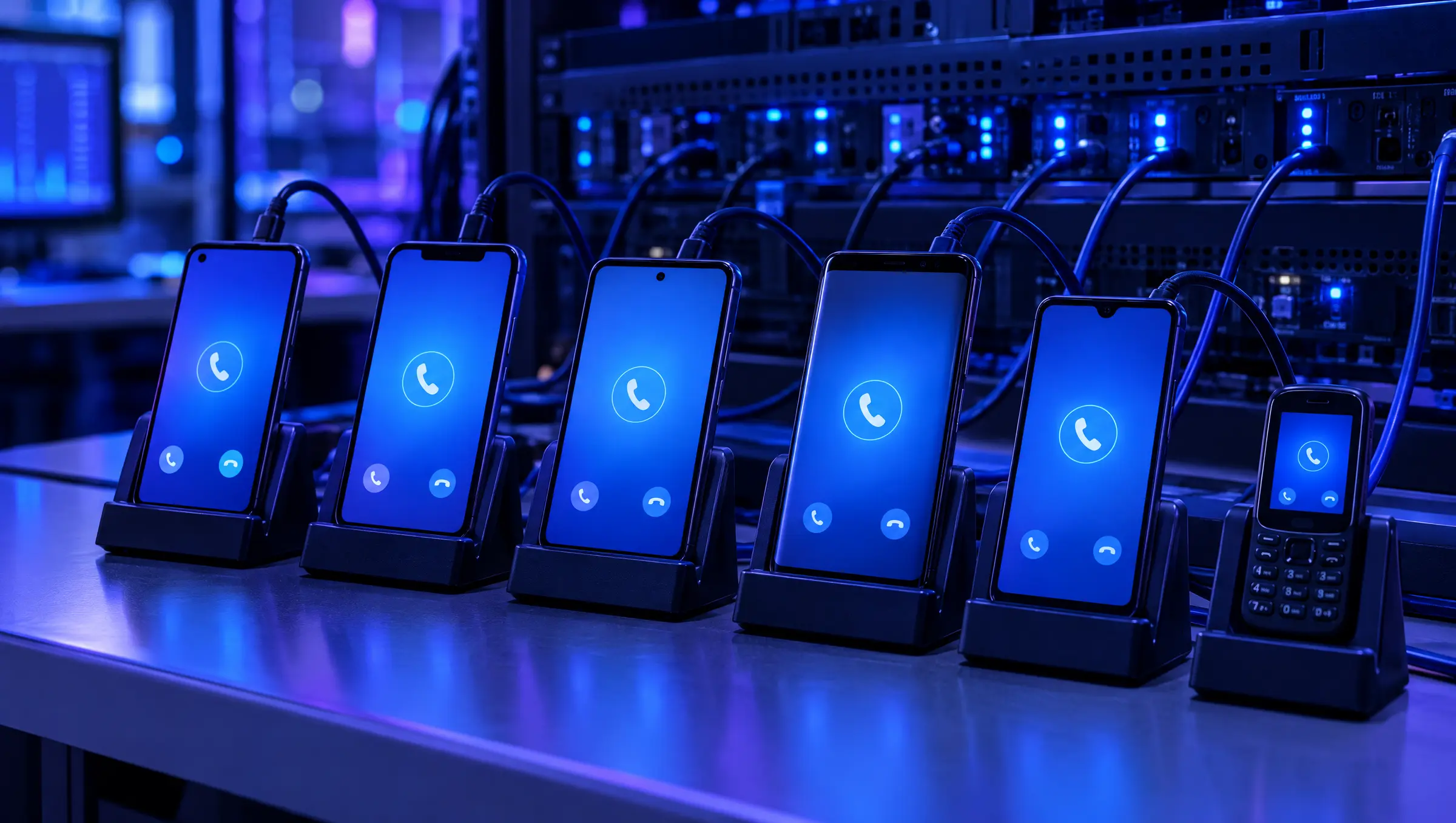
Phones on a test bench in a telecom lab, each showing a call screen

Quality you can read call by call

On the hosted switch, every destination on a supplier and on a customer is judged on answer-seizure ratio and post-dial delay from real sessions, and each verdict names the metric, the threshold, the sample and the window it rests on.

  • An ASR below 60% is a warning and below 40% a failure; a PDD above 3 seconds is a warning and above 6 a failure
  • Endpoints probed with a real SIP INVITE from every media address, with a verdict per address
  • Route reports raised from the failed call, and an automatic re-test when the seller marks it fixed
  • Every failed call carries its cause in plain English
A network engineer reviewing a dashboard of route charts at dusk

AI on the telephone network

AI for callers, AI that calls, and the phone lines for the AI other companies build, on the same voice network.

Minutes Network AI: talk to AI from any phone

Minutes Network AI is a phone number with an AI assistant on the other end. Dial a local number, ask in your own words, and hear the answer on the same call, from a smartphone, a basic phone or a landline. For AI companies, Minutes Network provides the numbers, the carrier connectivity and the real-time audio, and you keep your own engine.

  • No app, no data connection and no account: a voice call is enough
  • Searches the web mid-call and reads the results back
  • Your engine's audio over a secure WebSocket, the call over SIP, or a managed speech stack that calls your model
  • Local-rate, freephone and premium-rate numbers, connected on request
A woman at home making a call on a wall-mounted landline

AI voice agents over the routes you choose

Describe the agent in plain English and it drafts its own script and hard rules for you to edit. Pick a voice, test it in a simulated call, and attach it to a dialer campaign: on every answered call it holds the conversation and records what it learns as structured fields.

  • $0.25 per AI-connected minute, billed per second, on top of the route rate
  • A maximum call length that caps your cost per call
  • Campaigns of up to 128 simultaneous calls, with 13 caller ID rotation modes
  • Do-not-call numbers checked at the moment each number is dialled
A cellular tower above a city at dusk

Jingle Plug-In: a telecom revenue layer for Android apps

Jingle is an Android SDK. Users who opt in receive international calls on the normal incoming-call screen, and the app earns a share of every completed minute: typically 50% of net termination revenue, set in the partner agreement and paid monthly. Revenue is not guaranteed.

  • One dependency, Android 8.0 and later, native Kotlin, and works in Flutter and React Native apps
  • Calls reach the app through MinTech Flexible Connect: carrier SIP converted to encrypted WebSocket, with SRTP audio
  • Consent first: a plain explanation, the Android permission dialogs with a reason for each, and a one-time SMS code
  • Call audio processed in real time and never recorded; no location, messages or advertising IDs
  • Built for Google Play policy, with reference consent screens and Data Safety guidance
A person at home at night holding an Android phone showing an incoming call screen

The Accelerator: own dedicated ports on a live route

The Minutes Network Accelerator sells dedicated ports on a named wholesale voice route, provisioned new for each order, on a fixed 10-year term. Leave them on resale and Minutes Network traffic fills them, or run your own traffic over them. The margin they earn is not guaranteed.

  • Margin accrues live in the owner portal, read from the exchange that carries the traffic
  • Self-run capacity comes with a SIP address, an assigned IP, a technical prefix and credentials
  • Payouts by bank wire, or USDC on Base or Ethereum, from $50
  • Margin is potential, not guaranteed
A carrier line card with a row of ports, each lit by a blue status light

MinTech, now inside every product.

MinTech is the technology Minutes Network builds itself. Its five parts run inside the products above, and this is what each one does today.

MinTech Flexible Connect (MFC)

Live: the protocol and media conversion behind Jingle and carrier interconnect.

Flexible Connect converts between the way carriers send calls and the way apps take them. Carrier traffic arrives as standard SIP and is converted, signalling and audio, for app endpoints that connect over encrypted WebSocket, so a call from any carrier can end on a phone running an app with the Jingle Plug-In.

  • Carrier side: SIP on port 5060 over UDP or TCP, with G.711a, G.711u and G.729
  • App side: SIP over encrypted WebSocket (TLS), with SRTP media
  • Audio transcoded between carrier codecs and Opus, G.722 or G.711 on the app
  • IP or digest authentication for carriers, and an SMPP bind for SMS

MinTech Analytics Suite (MAS)

Today: the analytics inside the switch, the marketplace and the Accelerator.

Each product measures the traffic it carries and shows it to the people who need it.

  • Hosted switch: ASR, ACD, PDD, NER and MOS per supplier, and verdicts per destination
  • Marketplace: ASR, ACD and NER measured on real buyer calls, and an Exchange Score
  • Accelerator: margin, minutes against port capacity and fill, per route

MinTech Revenue Turbine (MRT)

Today: route blending on PacketExchange.

Revenue Turbine is live on PacketExchange: several routes and supplier trunks become one sellable product.

  • Up to 20 members in one blend
  • One weighted rate and pooled channels and calls per second
  • Coverage checked against every prefix you hold supply for

MinTech Development Sandbox (MDS)

Live: the developer sandbox on PacketExchange.

Development Sandbox gives developers the live system without the live consequences. Test keys are not a mock server: every request goes through the same validation, Smart Routing and rate lookup as real traffic on a real route, then stops short of the carrier.

  • Test keys for SMS, voice and verification, routed and priced on real routes, then simulated
  • $50 of invite-only sandbox credit that never touches your balance
  • Verification test sends return the code, so a check finishes without a phone
  • From sandbox to production by swapping the key

MinTech Originating Carrier Portal (MOCP)

Today: the buyer side of PacketExchange.

Originating carriers buy termination on PacketExchange and run it from one dashboard and one prepaid balance.

  • Compare routes on rate, CLI type and measured quality, and connect them free
  • Every call billed when it ends, straight from a prepaid balance
  • Failed calls with their cause in plain English, reported from the call itself

Build on the network.

Open a free PacketExchange account and top up from $5 by card or crypto, or talk to the team when you need a switch, capacity, AI or an SDK integration.

Minutes Network Explorer.

The real-time network dashboard: live call volume, quality metrics and global carrier analytics from the Minutes Network infrastructure.